
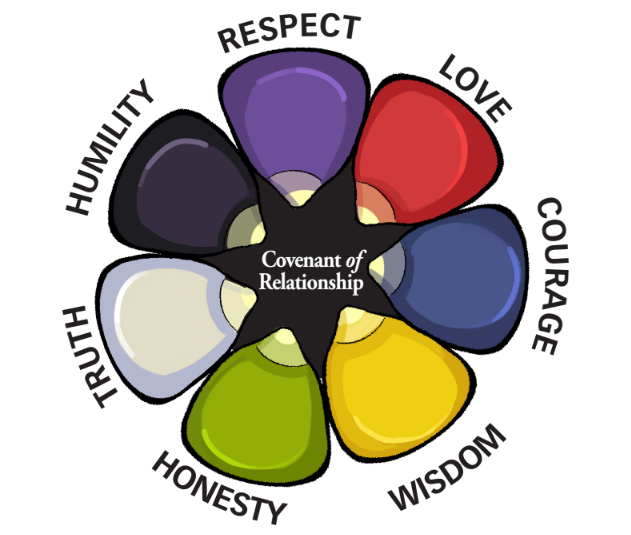
This post is part of an ongoing series expanding on the seven sacred teachings of Respect, Courage/Bravery, Love, Humility, Truth, Honesty, and Wisdom/Intelligence. This post explores the sacred teaching of Humility.
There is a version of humility that dominant culture is comfortable with. It looks like modesty, like not bragging, like saying “oh, it was nothing” when someone compliments your work. It’s a personality trait, a nice-to-have.
That is not the humility the Coalition means when we name it as a sacred value.
The humility we’re talking about is structural and spiritual. It’s the opposite of the Doctrine of Discovery itself — that 500-year-old theological claim that certain people (white, Christian, European) possessed the right to know, define, name, and ultimately own the rest of creation and the people in it. The Doctrine of Discovery is a doctrine of mastery. It assumes a knowing subject standing over and apart from the world, entitled to survey it, catalog it, and decide who it belongs to so it can be exploited for gain. Humility, rightly understood, is the theological undoing of that posture. It is not a personality trait we practice on top of decolonization work. It is decolonization work.
Here’s how I described humility in the book Sarah and I wrote: “Humility is about knowing our proper place in the scheme of creation and regarding ourselves rightly. I once heard Benedictine sister Joan Chittister define humility as thinking either no more or no less of ourselves than we should.”
Humility as “right-sizedness” is an antidote to the Doctrine of Discovery. The Doctrine required Europeans to think more of themselves than they should — chosen, superior, entitled to possess. But it also required them to think less of everyone else than was true — reducing the Earth, whole peoples, and even themselves to something less than fully made in the image of God. Real humility refuses both distortions at once. It will not let us inflate ourselves above anything else in creation, and it will not let us shrink anyone else beneath it.
Now Let’s Get Real
So far, I’ve been a bit more theoretical, although that theory has enormous implications. But now I want to bring the value of humility into our life together in the Coalition. I want to talk about how valuable and necessary humility is for a Coalition that is Indigenous-led and settler-accompanied — that is, one largely made up of white Christians, led by an Indigenous woman and other leaders of color. Here’s how I see the importance of that value in our life together.
Consensus in our Coalition community is not the same as settler consensus. In fact, I’m not sure consensus is even the goal. We who are settler-descended are following the lead of Indigenous leaders. Native leadership’s priorities may — and often will — differ from that of white settlers. Often, as settlers, we seek to serve our own institutions and constituencies’ needs, even if unconsciously. Even after co-founding this Coalition and being deeply involved in this work for 12 years, I am still humbled as I realize how quickly I and other settler-descended people can make the work more about us than about the liberation of an oppressed people.
For example, it’s common for settler-descended folks to want to do a book study or to do some historical work on the ways their family participated in colonization or benefited from it. That can be important work to do if it is oriented toward deepening the passion for doing the actual work of liberating an oppressed people. But too often, white folks do their own internal or historical work and think that is the work.
Imagine a settler-descended person who spends a year researching how his grandfather’s business operated on land taken from a specific tribe. Now imagine that same tribe, a year later, needs settler allies to show up at a hearing opposing a pipeline crossing that land, and he doesn’t show up, nor does he advocate for other members of his family and community to do the same. The family history became the project. It might have felt like reckoning but it never cost him anything in the present, and it was no substitute for what Indigenous communities actually need from us.
When Indigenous leaders speak, settler-descended members are called to listen and learn with humility. I recently heard an Indigenous elder say that humility requires white settlers to refrain from “mining” for the truth when talking with Indigenous folks. That word, mining, is not incidental. It names the extractive posture that shows up when settler-descended people, even those of us doing this work in good faith, enter conversation with Indigenous leaders treating truth as a resource to be extracted through enough questions, enough probing, enough getting-to-the-bottom-of-it.
When we encounter something outside our dominant-culture framework, our instinct is often to interrogate it until we’ve fully understood it. That instinct puts the onus on the Indigenous leader to keep defending and re-explaining their own understanding, and it draws on their time and energy as though those “resources” were simply available to us. Settler-descended folks can assume they have ready access to Indigenous leaders’ time, information, and emotional labor.
We want more information before we’re willing to trust a decision an Indigenous leader makes. We want to understand fully before we’re willing to follow. But demanding full comprehension is its own kind of extraction — it treats another person’s hard-won wisdom as something we’re entitled to mine until we’ve satisfied our own, often dominant-culture, logic. Humility asks us to do something genuinely countercultural here: to honor leadership and wisdom we may not fully understand.
A framework from Vanessa Machado de Oliveira, the Brazilian/Canadian scholar, has helped me name why this is asked of settler-descended folks in particular and not symmetrically of everyone. Machado de Oliveira distinguishes between what she calls people who participate in low-intensity struggle — that is, those of us who have benefited most from, and still live inside, the comforts and protections of the house modernity built — and people involved in high-intensity struggle — that is, those whose lives and lands have been put at risk to build and maintain that house. Often, those of us in low-intensity struggle may not understand the different interests and life experiences of those in high-intensity struggle. What is important to us may not be important to them because they are fighting to survive, while we may be struggling for something far less urgent or threatening.
I think of the difference, say, between a Coalition planning meeting where settler-descended members spend 20 minutes worrying about how a press release might affect our relationships with denominational leaders, while a tribal council spends that same 20 minutes deciding whether to relocate elders because a nearby mine has begun contaminating their water supply. Both are real concerns to the people having them. But one is about reputational risk to an institution, and the other is about whether people survive. When we don’t notice that gap, we can end up treating our interests as though they were the same — as though careful wordsmithing and their water supply belonged to the same order of urgency.
In addition, Machado de Oliveira says that comfort often leaves low-intensity struggle folks under-practiced at tolerating uncertainty, sitting with grief and complicity, and letting go of the expectation that things will resolve neatly once we understand enough. High-intensity struggle communities have not had that luxury. Their knowledge of the system — and of what it will actually take to survive and outlast it — isn’t partial or supplementary to ours. It’s the fuller knowledge, forged the hard way.
Humility – knowing our place, being right-sized – asks those of us formed in relative comfort to cede authority – real decision-making authority, not just polite deference — to those forged in struggle. This isn’t because we have nothing to offer but because our comfort hasn’t equipped us to lead this particular work, and their struggle has. Ceding authority, seen this way, isn’t self-erasure. It’s accuracy. It’s putting decision-making where the fuller knowledge lives.
Last, settler-descended folks need to look inward before taking offense at conflict involving an Indigenous person or person of color. We need to ask: What am I carrying into this moment? Where is my reaction coming from?
It is one thing to affirm, in principle, that we are dependent creatures who don’t get to master the truth through enough questioning. It is another to notice, in the middle of a conflict when our own nervous system is aroused, that our injury may feel outsized partly because we are unaccustomed to not being centered — and to hold that noticing without collapsing into shame or defensiveness. In addition, settler culture teaches us to demand redress based on ideas of fairness that don’t apply where power is unequal — and power is always unequal between Indigenous and settler-descended people. We often expect an equal “settling of the score” as if every relationship were a transaction between equals. Humility — understanding our place vis-a-vis this other person — interrupts that reflex.
An Exercise, Not an Arrival
Humility is an exercise — something we practice, not something we achieve. We are never done learning. One of the Doctrine of Discovery’s deceptions was the idea that some people had arrived at full knowledge and authority, while others had not. Humility refuses that story. It insists there is no arrival, no point at which we’ve finally understood enough to stop listening, to stop questioning ourselves, to stop practicing right-sizedness.
This is a spiritual claim and a political, structural one. To be a creature among creatures, dependent on a Creator and on a creation we did not make and do not own, is the truth of our condition. The Doctrine of Discovery built an entire civilization on the lie that some people could stand outside that humble truth. Practicing humility — really practicing it, as an exercise, daily, imperfectly — is how we return to truth. It is how, together, we keep choosing life.

Sheri Hostetler is co-founder of the Coalition to Dismantle the Doctrine of Discovery and is currently the Administrative Leadership/Advancement Director. With Sarah, she co-authored the book “So We and Our Children May Live: Following Jesus in Confronting the Climate Crisis” (Herald Press 2023) and co-hosts the Dismantling the Doctrine of Discovery Podcast. She has been the Lead Pastor at First Mennonite Church of San Francisco since 2000. She was also one of the founders of what is now called Inclusive Mennonite Pastors, a coalition of pastoral leaders seeking LGBTQ+ justice in the church. A poet and writer, her work has appeared in “A Cappella: Mennonite Voices in Poetry”. She is trained as a spiritual director and a permaculturist, and lives with her husband, Jerome Baggett, and their son, Patrick, on an island in the San Francisco Bay.
