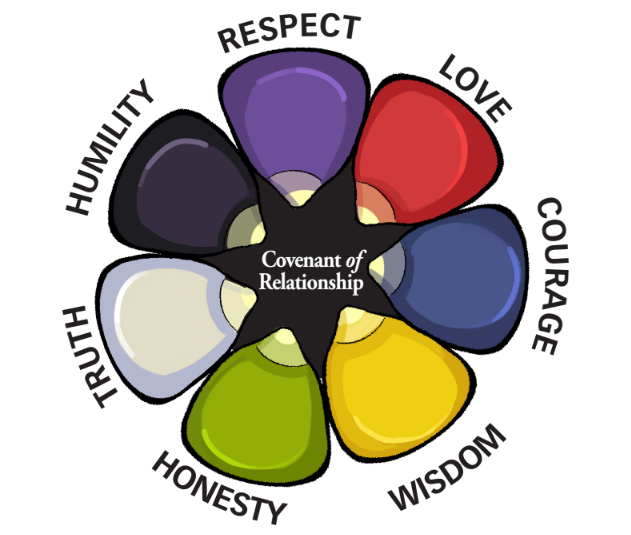
This post is part of an ongoing series expanding on the seven sacred teachings of Respect, Courage/Bravery, Love, Humility, Truth, Honesty, and Wisdom/Intelligence. This post explores the sacred teaching of Courage.
We are winding down from a polarizing day. For some, July 4th is a day of hot dogs and fireworks and vacation. For many, this is another day of dissonance, where the mainstream rhetoric of liberation and independence are not aligned with the historical and current realities. For Indigenous people, for Black and Brown people, for immigrants, for working class folks – for most people who are not white, Christian, and disconnected from systematic injustices – in order to ‘celebrate’ this day we must numb a part of ourselves, a part of our histories. It takes permeating courage for any of us humans to not turn away from these truths.
Before I continue on, I want to thank you for feeling, for breathing through the numbing of capitalism and colonialism. No matter your identity, if you find yourself reading this, I trust you are on the same path as me, and it is an honor to humbly and courageously move alongside you. To feel, to be present with the world as it is, and as it is changing, is an act of readying ourselves for, and bringing about, the transformed world we are all dreaming, praying, working towards.
The Torah portion we read the last shabbat of June, Parshat Chukat-Balak, has many potent messages readying us for this world-tending work. One interwoven Presence I want to draw out is the Divine Breath who enlivens our creative spirit, who encourages us to attend to matters of death with intention. Jewish tradition sees the coming of the luminaries, of nightfall [alongside immersion in water] as a purifying time: v’tameh ad-ha’areiv [Numbers 19:7; Berachot 2a:13-2b:4]. By purifying, I don’t mean it simply erases that which caused impurity; I don’t mean turning away from the horrors of injustice, or to do away with the inherent diversity of being alive. Jewish tradition sees conceptions of purity and impurity as alchemizing processes relating to ritual readiness. As a fellow Coalition Organizer, Amanda Pittman (Tewa [Pueblo] descendant), says, purifying is ‘orienting our mind and body towards ceremony.’ Pure means to be intentionally ready to encounter the Divine, through each other, through the elements, through ceremony.
To attend to our purity, in this way, takes intentional courage. Our Chaplain, Reverend Canon Debbie Royals (Pascua Yaqui), reminds us that courage is embracing vulnerability as a strength, building our capacity to endure discomfort, to stand alongside those protecting our waters and our Mother Earth. Courage is to attune to ourselves enough to sense when we are ready to encounter the Divine. It is upon us to follow our own traditions of cleansing in order to bring ourselves to that place of readiness. This iterative tending process takes vulnerable honesty; it takes courage.
The Torah portion at the end of June continues to say that when we encounter death – and I add in evil, that which brings us towards death – we become impure, ritually unready. In order to come back to readiness, we must both acknowledge the grief and the reality of our state, and work with someone who is ritually ready and willing to work with us towards a return, a tikkun, to that state of readiness.
In our webinar Decolonizing 250 years of America: Reckoning with Our Past and Weaving a Collective Future, elder and artist Diane Schenanodah of the Haudenosaunee Confederacy shares a story that is part of a much larger collection of teachings in establishing Peace through love and forgiveness. This story speaks to self-recognition and accompaniment by others as a pathway towards healing and Peace, a pathway of reorienting towards our interconnectedness as sacred.
I won’t do the story justice, so I highly encourage you to watch the recording linked above to hear this story as shared by Diane Schenanodah herself, who disclaims that this story is usually told over 12 days, alongside the other heartbreaking and world mending wisdom shared.
Hayawenta, who was so grieved and heartbroken when Tadodaho, a war-hungry leader, killed his daughters, threw himself into a lake only for the waters to be ‘pulled aside’ by geese, displaying a wampum shell at the bottom. He took this as a sign, and began a ceremony for his healing through beadmaking, with each bead holding a particular intention. Through this ceremony, Hayawenta, alongside Jigonsaseh, the Great Mother and the Great Peacekeeper, found peace and healing and brought this back to their people at the capital of Onondaga. When they tried to share this peace and healing with the then-war-hungry leader Tadodaho, he wanted nothing to do with it! So they continued to travel to all the nations, sharing their path towards peace and healing, and with all the nations now alongside them, they went back to Tadodaho and started to sing songs of love and forgiveness to him. This broke his brittle war-minded heart, the Great Mother pulled the snakes from his hair, and all held hands and threw their weapons under the Tree of Peace to say they will fight no more.
Just like Tadodaho, not all people can hear these messages of peace right now, but may we be spreading our word to those who are receptive and trust that when we all come together, we will move those who are seemingly unwilling to move towards interconnected ways of life.
This alchemizing potential shows up in the across-time-transformation of a piece of text originating in this past week’s Torah portion. Initially, the Torah praises good lands, good tents, good places of prayer, ending with violent language of bone crushing, and arrows smashing, and nation consuming, and overcoming our foes: mah tovu ohalecha ya’akov mishkenotecha yisrael…yochal go’yeem tzaraiv v’atzmoteihem y’gareim v’cheetzav yeemchatz… (Numbers 24:6-9). Oof, quite violent, ey?
My childhood rabbi, Brant Rosen, reminded us in synagogue two weekends ago, that the rabbis of the 9th century, using their own spiritual creativity and proclivities towards peace, transformed this text to one that too honors good lands, good tents, good places of prayer, but instead of ending with violence, ends with reverence, prostration, and a request to the Divine that our prayers [and actions] be favorable to God: mah tovu ohalecha ya’akov mishkenotecha yisrael; va’anee b’rov has’decha avo beitecha esh’tachaveh el heichal kadsh’cha b’yeeratecha…v’ani eshtachaveh v’acharayah ev’reichah lifnei adonai osee…(Shacharit Liturgy) This transformation is an embodiment of the movement from acts of violence towards acts of reverence to the Creator and all the Creator creates. This transformation is an opportunity, each morning, we sing this prayer to re-member our role as reverent vessels of love and forgiveness, mending this broken world towards wholeness, just as Hayawenta and Jigonsaseh sang Tadodaho back to wholeness.
As many around the country praise 250 years of independence, we in the Coalition, and so many of our partners in fighting for justice, reckon with the horrific reality of what ‘independence’ has meant for so many of us. Through our reckoning, we take the opportunity to be spiritually creative, just like Hayawenta and Jigonsaseh, just like the rabbis of the 9th century. We transform the horrors of our inheritance into Good Works, into reverence towards all of God’s creations and the Divine Kindness that flows from our prayerful reverence.
It’s not too late to actively join us in this proliferation of Another Way. Host a prayer vigil in your community to call forth a more interconnected way of being in this 250th year since the Declaration of Independence, or write a letter to the editor about America 250, recognizing colonization began more than 250 years ago and highlighting the way the Doctrine of Discovery continues to show up in our present day legal structures.
Or chadash al tziyon tayir v’neezkeh koolanu l’oro.
May The Divine One shine a new light on Zion, and may we all merit speedily from its radiance.
Baruch atah Yah, yotzer ha’me’orot.
Blessed are you, God, the creator of the luminaries.
May our work be in service of this new light shining on this world, a light that is new for us, yet one our ancestors have known. A light we pray towards. A light we act towards.
May we be courageously restoring the reign of interdependence across our land mass, and may that work ripple throughout the world.
May we remember that we need each other to renew our readiness, with reverence to the four elements, to all the critters and crows, that make our world whole.

molly block finds home in fallen, crinkling leaves, bodies of water, and the breath of a cooling breeze on a hot Sonoran Desert day. Born and raised in Chicago, IL (lands where Očhéthi Šakówiŋ, Myaamia, Ho-Chunk, Potawatomi, Kickapoo, Peoria, and Kaskaskia peoples moved through for centuries), she now twirls and whirls her mindbodyspirit (ir)reverently on occupied Tohono O’odham and Pascua Yaqui lands, also known as Tucson, AZ. As a Kohenet, a Jewish community-minded ritualist, she spends her time kissing the earth, singing songs the winds inspire, and imagining and practicing ever-refined ways of relating to and with each other. This Work, together, builds the interconnected power we all crave, a power outside of structures of domination that has upheld and propelled the country falsely claiming to be the land of the free.
Reach out to molly@dismantlediscovery.org if you want to create new pathways+rituals for connection in your community, troubleshoot weaving networks across political ideology, or are in the Southwest and want to frolic and grieve and dream together!