Native American and Palestinian histories are linked by settler colonialism. What happened a little over 150 years ago along the banks of the Washita River in Oklahoma Territory, and before that along Sand Creek in Colorado, is happening now, along the banks of the Jordan in Gaza.
Both countries, the United States and Israel, were created by means of population displacement and land dispossession. Settler colonialism is the removal of native peoples from homelands to make way for settlers–people from other ethnicities races, and lands.
In general, historians identify three different types of colonialism: extractive, exploitative, and settler. Extractive was present in much of our early colonist history. Think of the fur trade that spanned the North American continent or today the extraction of copper from sacred Apache lands in Oak Flat, Arizona. Exploitative is when local people are coerced under threat of violence to work–they are usually enslaved. Examples include rubber plantations in Africa and sugar plantations in the Caribbean.
In both extractive and exploitative, the subjugators, the conquerors, are in it for short-term profits. They harvest the crops and minerals and then move on to the next lucrative endeavor or area. They usually don’t settle although all of these colonialisms overlap. In settler colonialism, land is the main commodity; settlement the primary goal. Unlike the other colonialisms, settler colonialism requires the complete elimination of the native population. It is often closely linked with genocide.
There are many ways to clear the land of its people. Here in the U.S. disease wiped out as much as 90% of the native population. Powhatan, the father of Pocahontas, was the only survivor of three generations of his family members. He lamented,
“You may understand that I having seene the death of all my people thrice, and not any one living of these three generations but my selfe, I know the difference of Peace and Warre better than any in my Country.”
Frontier homicide, government-funded massacres, and treaties followed disease and further reduced First Americans’ land holdings. Many of Virginia and Maryland’s First Americans were absorbed into other tribes further west, tribes more able to withstand the pressures of settler colonialism and nation-state aggression–at least for a time. Ultimately, remnants of once-thriving communities were removed. In Virginia, removal started in 1813. By 1850, practically all First American inhabitants in Virginia and Maryland had been removed.
By what date will practically all Palestinians be removed? Following the genocide of Jewish people during World War II, Israel was created in 1948. The land that made the nation was taken from the Palestinian people. We are witnessing the devastating consequences of settler colonialism at its absolute worst.
As inheritors of settler colonialism’s blunt end, Palestinian children and Native American children have too much in common.
Surviving…
a massacre,
a genocide,
a removal is capricious, often accidental.
The children who survive might be saved by a hole dug into a river bank, one last bullet in an ancient pistol, a cloud shadow cast over a hiding spot in the Tall Grass.
They might be saved by a fallen beam resting on a kitchen table under which they cower, a tired humanitarian aid worker, a sip of water, a dirty tent in a refugee camp.
What is our legacy to these children? Are lamentations all we can offer?
Like Powhatan’s words, laments circle. They circle through the years and through the camps:
Refugee camps.
Chief’s camps.
Camps of children.
If the children of survivors were to return to the Jordan, as the children of survivors have returned to the Washita and Sand Creek, would they still hear the cries, the explosions, the pop, pop, pop of guns? Would they still smell the fires?
How many generations will pass before the laments stop circling? How many generations will pass until the practices and legacies of settler colonialism finally tire? How long until settler colonialism loosens its grip and swirls away as innocuous as a gentle breeze on a soft spring day?
Now, the breeze is not gentle. The horrific legacies are still with us. Like a persistent wind, they blow through us, chilling us at our core. The bad stories whip through the years and through our camps. The names become nightmares. They are passed not just in legend or lament, but in blood and bone, from grandmothers to their children’s babies.
Sand Creek
Washita
Jordan
Sand Creek
Washita
Jordan
Jordan
Jordan
During the last week in July, our camp, here at Hyattsville Mennonite Church, will host Mennonite Action marchers. On the lands of Algonquan-speaking people, and along the banks of their homeland rivers, the Anacostia and the Potomac, we settlers can resist and renounce our own colonialism’s pernicious history and its devastating present. We can offer prayers, songs, shelter, food, our bodies in arrest. We can stand in solidarity with First Americans and Palestinians.
Like the marchers, we can step up to confront settler colonialism.
We can step up and hold it, contain it, march it, and breathe into it, turning laments into song and singing it away.
This lament was originally written for the July 14 service at Hyattsville Mennonite Church
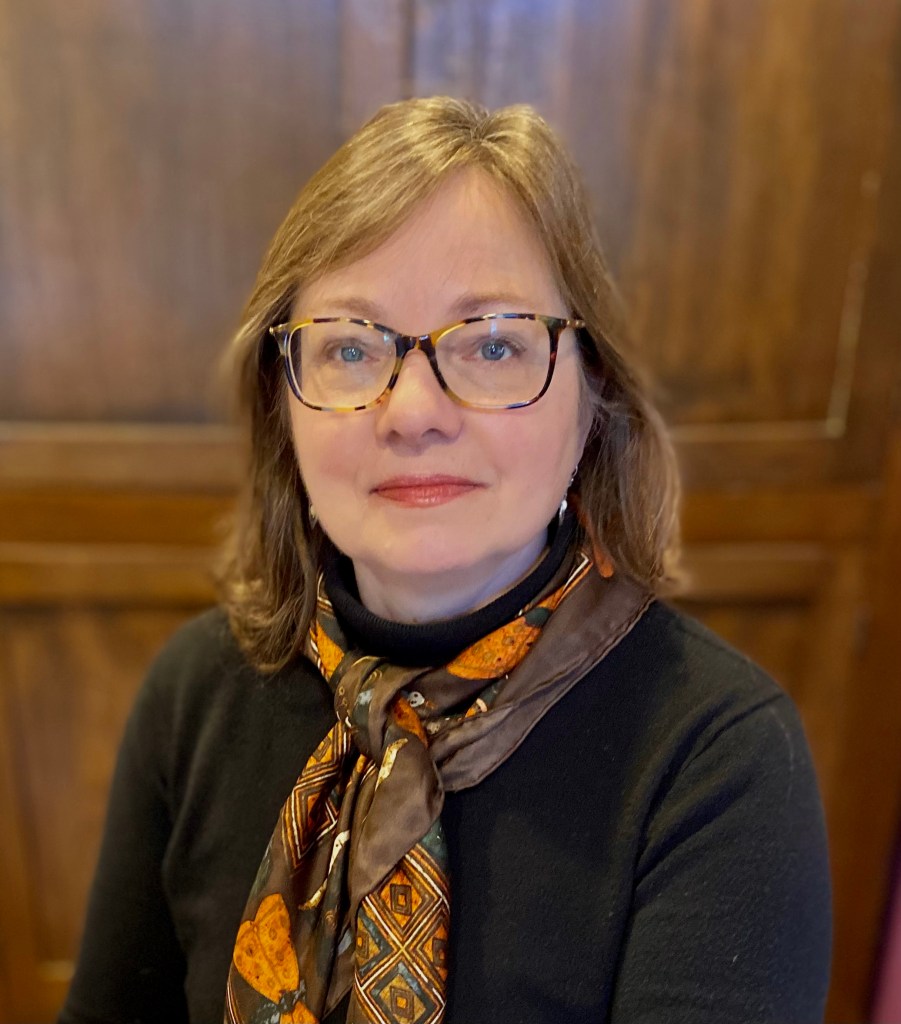
After teaching since 1985, Kimberly D. Schmidt is now a recently retired professor of history and former director of Eastern Mennonite University’s Washington Community Scholars’ Center, a position she held for 23 years. Her teaching included developing twelve walking tours of Washington DC neighborhoods and a canoe paddling environmental history tour of the Anacostia River. She encouraged her students to access the histories of DC’s multicultural neighborhoods through various visual and performing arts media. She recently taught History of First Americans at EMU. She is a member of the Allegheny Mennonite Conference’s Repair Committee and currently serves EMU as an Affiliate Professor of Gender History.