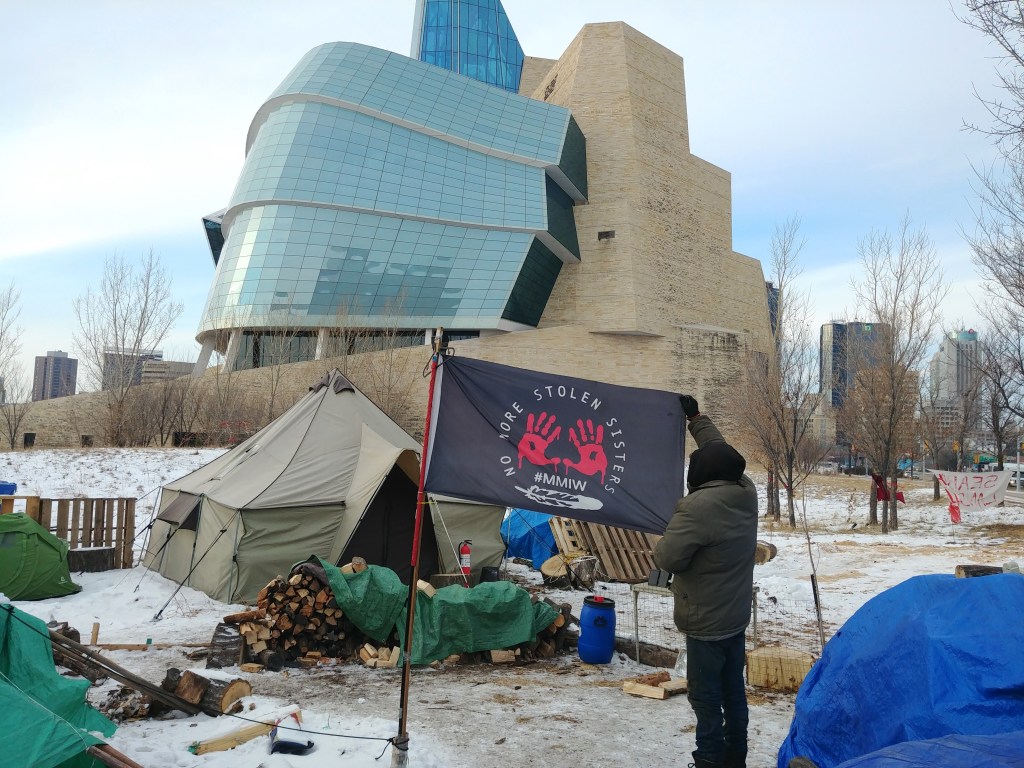
The December winter nights are getting quite cold here in Manitoba, Canada. For most of us, including myself, a comfortably heated home is a norm we would be more than reluctant to give up. And yet for well-over 6 months, an Indigenous led camp has chosen to maintain an ongoing sacred fire outdoors near the Canadian Museum of Human Rights here in Winnipeg.
The site, Camp Marcedes, was established not as a protest, but as an awareness camp by family members (and supporters) of Marcedes Myran, whose remains—along with at least three other Indigenous women from Winnipeg—are believed to be in Winnipeg’s Brady Road Landfill, the victims of a serial killer. Another encampment, Camp Morgan (honouring victim Morgan Harris) has had an ongoing presence for a full year just outside the landfill itself. Both of them are calling on the Manitoba Provincial government to conduct a search of the Brady, as well as the Prairie Green Landfills, and ideally “move landfill operations to new ground, erect monuments and turn the existing landfills into areas where we can visit our relatives who are still there.”
A federal assessment undertaken (only because of the hard work and initiative by the families and community) found that it would be expensive, but still feasible to conduct a search of Brady landfill. However, our provincial government at the time flatly refused to consider a search, citing safety concerns, and even used it as a campaign issue in the provincial election this fall—possibly seeking to appeal to white attitudes of dismissal or disdain. While their party lost and the new government has made commitments to moving forward with a search, it has yet to come to fruition.
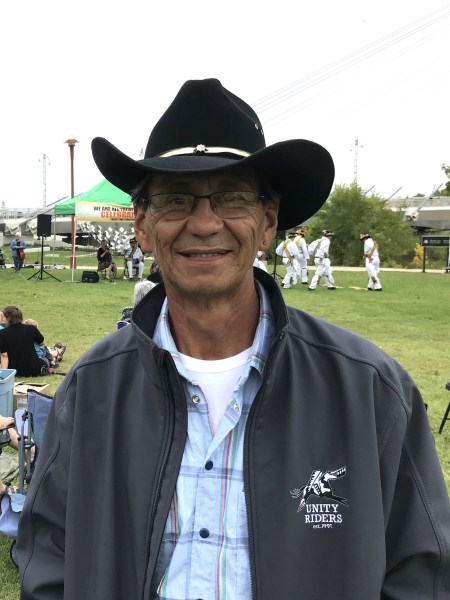
Chatting with Marcel French, an Elder firekeeper who continues to maintain Camp Marcedes, he remarked that it is not easy to stay awake and warm when the chill sets in during the quiet hours late at night, but they are committed to remain, keeping their sacred fire burning, until the search is very clearly and actively underway. “The minute that happens, then we’ll start packing up,” he says. Until then, they are continuing work to winterize the camp despite fewer volunteers coming out to provide respite and other forms of support.
As horrific as it would be for any family to lose a loved one in this way, there is a larger colonial context to this situation in Canada that puts the commitment of these camps into starker clarity. Violence against Indigenous women, including assault, rape, domestic abuse, and murder have continuously affected too many families and communities here.
According to the Assembly of First Nations in Canada, “Indigenous women are four times more likely than non-Indigenous women to be victims of violence.” Community groups estimate that at least 4000 Indigenous women, girls and Two-spirited individuals have gone missing or been murdered since the 1970s, likely more. In Making Space for Indigenous Feminism, Mary Eberts profoundly states that simply being an Indigenous woman is a “high-risk life.”
Indigenous women's experience of violence in Canada is complex, pandemic, and horrifying. They are disproportionately the targets of crime by non-state actors, and cannot rely on police and other authorities for protection. Those authorities may themselves commit violence against Indigenous women… Indigenous women are over-arrested and over-criminalized while constructively denied the benefit of the law.
Mary Eberts
After years of calling the federal government to act, a National Inquiry into Missing and Murdered Indigenous Women and Girls, as well as 2SLGBTQQIA people, was initiated between 2017 and 2019. This inquiry heard from over 2000 survivors and family members about the realities that virtually all Indigenous communities know acutely. And it concluded that these acts of violence collectively amount to “a race-based genocide of Indigenous Peoples.”
Of course, this is not isolated to Canada. Around the world Indigenous women face disproportionate levels of gendered violence, harassment and murder, including the United States where “violence against indigenous women has reached unprecedented levels on tribal lands and in Alaska Native villages,” according to the Indian Law Resource Centre. Of course, the patriarchal and colonial structures that undergird this gendered violence have been part of our both our nations’ histories since Europeans first arrived, including broken Treaty agreements and policies of forced removal of Indigenous peoples to facilitate settlement of land.
In Canada, colonial laws pertaining to First Nations and Inuit were consolidated into the Indian Act of 1876, which, among many other unjust restrictions, enforced communities to set up male-centered, colonial governing structures, thus disintegrating matriarchal and/or traditional communal systems. Many First Nation women were further denigrated through policies of enfranchisement after marrying non-First Nation men. Moreover, from 1820 until the 1990s, the Canadian federal government took First Nations, Inuit and Métis children from their homes and communities and literally confined them in Residential schools run mostly by church denominations.
Over seven generations, at least 150,000 children were taken, usually for 9 to 12 months of the year. And according to hundreds of survivors’ testimonies to the Truth and Reconciliation Commission of Canada, the vast majority faced physical, sexual and psychological abuse designed to intentionally strip away their language and culture. Thousands more died in the schools, a reality Canadians are becoming more conscious of through recent searches for unmarked graves. This largely mirrored a similar history of “Indian Boarding Schools” in the US, as well.
As the Residential School System was beginning to wane, persisting negative, colonial attitudes about Indigenous lifestyles enabled child welfare authorities to continue removing children through adopting them into non-Indigenous families. This scooping of children from their homes was a regular practice in the 1960’s until the 1990’s. Firekeeper Marcel is a survivor of the “60’s scoop” which split apart his Anishinaabe birth family and separated his siblings. He was eventually adopted into a Mennonite family where he lost his Indigenous language and culture, was punished when he didn’t speak Low German, and told that his birth family were “heathen.”
And this colonial tragedy continues today, just in a slightly different form, with hugely disproportionate numbers of Indigenous youth in the child welfare system—nine out of ten youth in Child and Family Services of Manitoba, for example, are Indigenous. Despite many well-meaning care givers, we know that many of those aging out of foster care end up in vulnerable life situations or on the street, which contributes directly to the violence perpetrated especially on those of marginalized genders. Many Indigenous folks, like Marcel, who share these type of experiences, seem to know in their bones that the suffering of one is the suffering of all–that we are all related as kin–and thus need to stand together in solidarity.
Yet, as a non-Indigenous, white male, in my comfortable privileged space, it could be much too easy to merely be saddened by this reality but choose to look away and not to do anything to change the policies and attitudes still entrenched in our lives and institutions today. Moreover, the Calls for Justice in the Final Report of the National Inquiry—addressed not just to government and institutions but to all Canadians—call on me to actively work to “break down barriers and to support others in every relationship and encounter” (15.4).
I’ve personally been inspired by a number of non-Indigenous folks who have gone out of their way to walk alongside the camps calling for a search. Michael and Barbara Young, two non-Indigenous friends who attend a Mennonite Brethren congregation, have been in relationship with the families at Camp Morgan even prior to its creation. Michael says that during the pandemic he realized he’d become unintentionally segregated: “I knew this needed to change, had no idea how to make that happen, and found that Christ met me where I was at and led me to where we needed to go together.” This led to an intense period of listening to and learning from non-white voices, and he says Drew Hart’s first book, Trouble I’ve Seen, summed up the sense of vocation which distilled for him during this period: “As we follow Jesus into the world, we must join with racially oppressed communities. We must so deeply identify with them that their struggle becomes our struggle.“
Thinking back, Michael and Barbara say their astounded by how much they’ve been through together with them in friendship & support, including two blockades, loss of a tepee in a fire, building a wigwam together, a wedding, arrests of two community members, two dear friends’ deaths, speaking up to both his own denomination and the entire provincial government, and being present during 10 days of deeply emotional pre-trial hearings. “All of this struggle has brought us closer.”
When I think about what it will take to shift the trajectory of missing and murdered Indigenous women and girls, and the broader ongoing colonial violence of our societies, I’m convinced it is precisely this type of relational solidarity many more of us need to engage in to the extent we’re able; to actually know the other and to identify with them as real people—family and friends who deserve the same dignity we all do—so that their struggle becomes our own.
Kerry Saner-Harvey lives in Winnipeg as a guest on Treaty 1 Territory. He works as the Program Coordinator for the Indigenous Neighbour’s Program of Mennonite Central Committee (MCC) Manitoba, aiming to facilitate relationships between Indigenous and non-Indigenous people towards reconciliation and strategies for justice. In the past, Kerry has worked with First Nations youth in Cranberry Portage, Manitoba; did restorative justice and community building work with MCC Newfoundland and Labrador; and supported peacebuilding opportunities while serving with MCC in Bangladesh.