
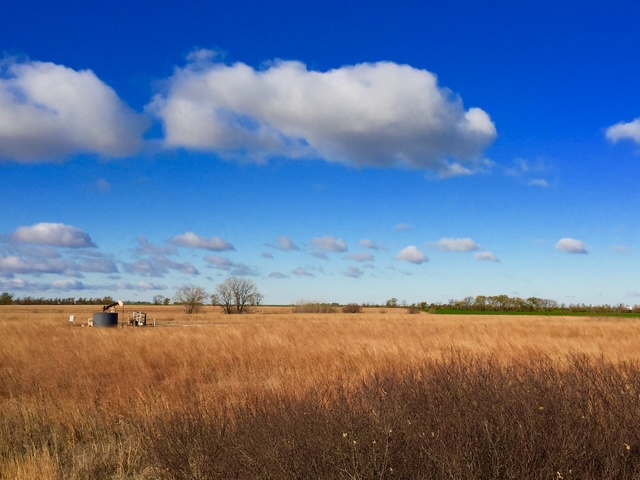
I will introduce myself, first, in the context of what I know of the Indigenous presence in Kansas where my ancestors started their lives in the US. All 8 of my great grandparents were Mennonites that immigrated to the US in 1874 where they settled on the plains because of their history as farmers. Of the many thousands of Kanza (Kaw) people who inhabited a homeland of some 20 million acres prior to 1825, about 500 destitute survivors remained when the US government forced them to cede their remaining lands in 1873, a year before my ancestors arrived. Federal Land grants were given to the railroad barons and they were allowed to sell parcels for their own profit. My ancestors benefited from these cheap land prices.
My grandparents and then my parents continued farming the land. They grew mainly wheat with a few other crops as well. My husband, Mike, and I moved onto one of these parcels in 1985 and built a house where we lived until 2017. During that time, we turned that property into native prairie grasses, and our neighbor who owns bison now grazes them on those grasses. I still have legal possession of that prairie (I prefer not to say that I own the land).
Mike, now deceased, and I were (and I still am) influenced greatly by The Land Institute (TLI) in Salina Kansas, whose work is dedicated to sustainable agriculture. The attached graphic of grass roots was done at TLI. As a result of all that we learned at TLI, we felt that the land being used to grow wheat would be better served by turning it into native prairie. The US Department of Agriculture also had a program that helped us to pay for the cost of the planting. So we pursued this idea and have been most gratified with the results.
I have learned that Indigenous people have a relationship with the land that settlers have not understood. I do believe that if Indigenous ways had not been taken over by settler colonizers, we would not be in the environmental crisis that we are today. In the words of Robin Wall Kimmerer in her book Braiding Sweetgrass, she says, . . .land “was everything: identity, the connection to our ancestors, the home of our nonhuman kinfolk, our pharmacy, our library, the source of all that sustained us. Our lands were where our responsibility to the world was enacted, sacred ground. It belonged to itself; it was a gift, not a commodity, so it could never be bought or sold.”
The land as it existed before my ancestors moved there was a healthy ecosystem. Native prairies provide invaluable environmental benefits, from enhancing biodiversity and soil health to mitigating climate change and improving water quality.
Native prairie ecosystems are home to a rich diversity of plants, animals, and microorganisms, many of which are not found anywhere else. The native grasses that we planted are little bluestem, big bluestem, switchgrass, side oats gramma, and Indian grass. These grasses, along with flowers that are native to prairies offer much to a wide array of wildlife. Birds are fed from their seeds, shelter for warmth and nesting for some species such as quail and meadowlarks, and protection from predators. They also feed on the insects that are part of the ecosystem.
The prairie plays host to numerous insects and pollinators which contribute to the overall biodiversity of the ecosystem.

The deep root systems of native prairie plants play a crucial role in maintaining soil health. These extensive root systems can reach up to 15 feet deep (see graphic), comparing that to non-native grasses that have roots only a few feet deep. The deep, fibrous root systems improve soil permeability allowing rainwater to be absorbed and stored more effectively. This helps to prevent both flooding during heavy rains and drought during dry spells by maintaining a steady supply of groundwater. Nutrients are also saved more effectively in this soil structure.
Native prairies are highly effective at sequestering carbon, a key factor in mitigating climate change. Their deep root systems store large amounts of carbon in the soil, a process known as carbon sequestration. Research indicates that prairies can store more carbon per acre than forested lands, making them an important natural solution for reducing atmospheric carbon levels.
The Great Plains were once home to millions of bison, but they were nearly wiped out by the colonial settlers. Today there are about 5,000 bison in Kansas. Having bison graze on this prairie is an added benefit to the environment. A Kansas State University study found that reintroducing bison to tall grass prairies can double biodiversity of native plants and increase drought resistance. This finding was replicated by cattle but to a lesser degree.

As we face growing environmental challenges, the preservation and restoration of prairie ecosystems offer a powerful tool for building more sustainable, resilient landscapes.
The death of my husband and other circumstances required my vacating our home on that prairie, but I have a great love for it and hope that I can honor it as the Native people who preceded me did before they were so unjustly removed. When I can, I relish walking on that sacred earth and know that my relationship to it nourishes me emotionally and spiritually. I am most grateful to the Kanza people along with other earlier Native inhabitants for caring for this land before my settler ancestors arrived.
“The earth does not belong to us. We belong to the earth.” Chief Seattle.

Valetta Seymour is a 78 year old retired Family Nurse Practitioner. She recently moved from Kansas to Nashville in 2023 to be near family. Valetta has joined the First Unitarian Universalist Church of Nashville where she has found an active community engaged in social justice, having recently started a new Indigenous interest subgroup.

One Response
Brilliant and clear expression of your love for this place, and its ancient truth.
And your transcendent bond with this living system that is a part of you.
Thank you.
💛