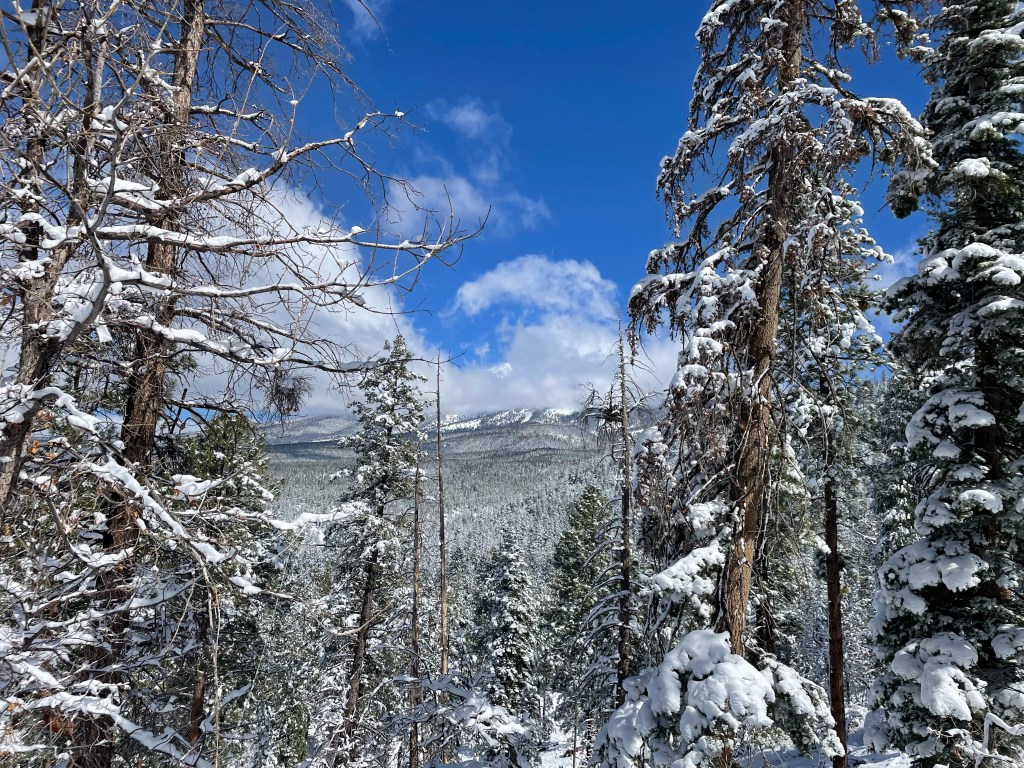
Dookó’oslííd/Nuva’tukya’ovi covered in a blanket of snow. Photo by Lydia Breunig
Protecting sacred land requires preparation for a longer journey.
All land is sacred.
Yes, this is true.
All places, all lives, are interconnected. As in a web.
When one part is torn, the harm ripples through and impacts the entirety.
But some places have unique (not more, not better) sacred significance. As my friend, Carol Rose, a Mennonite pastor, says, “Not only is all creation sacred because God made it, but there are also key places that God imbued with some particular power for good and that have been tended in prayer, and that power has deepened over centuries through ceremony and prayer.”
Places like:
Chi’chil Bildagoteel (Oak Flat) for the Apache People
Dookó’oslííd/Nuva’tukya’ovi (The San Francisco Peaks) – just two names in Diné and Hopi for spirit place that carries many different names in many different languages
“Wii’i Gdwiisa” (Red Butte) for the Havasupai People.
These places have been tended to by the prayers and ceremonies of people indigenous to this land since time immemorial. They are places of origin, places where water flows, places where spirits live, places where we realize ourselves as part of creation in connection with mother Earth.
My European ancestors had (have) places like this too. Springs where food and flowers were left. Mountains that reverberated with songs, with bells. Oak groves where people danced and feasted. Hills that embraced and remembered buried kin. Caves where paintings came alive with firelight. Some of these places still hold our stories. Some places are still honored as sacred and accept gifts. Although we may not remember entirely why, there is a deep knowingness that these places hold unique power as their own and also as part of the web of creation.
As a European settler descendant on Turtle Island, it is incumbent on me to listen to the indigenous people of this land. To listen to elders who are willing to take the time and energy to explain to me the sacred significance of these holy sites and how to behave. So that I may re-member.
Rose Toehe, a Diné elder, teaches me how to approach Dookó’oslííd. She explains, “Our sacred Dookó’oslííd to our Diné people is a place for reverence, prayer, gratitude, blessings, solace and at times a place to seek guidance and understanding…we must have a purpose to ascend on the Sacred Mountain – a purpose that conveys reverence for the place and the Holy Ones or Deities that dwell there and to honor the Mountain Herself. We ask permission to step into that space. We try to teach our non-Indigenous relatives that they too can hold space to have that sense of holiness and sacredness on Dookó’oslííd. Keeping that teaching in mind, heart, and spirit is when one can journey to that sacred space “in the right way” and for the right specific purpose/s.”
I am learning.
To enter these sacred places requires respect, yes, but also reverence.
To visit requires prayer, but also preparation.
This is not about the destination, but the journey.
This is a pilgrimage.
A pilgrimage begins at home. It begins before we place our foot on the earth pointed in the direction of our destination.
A pilgrimage begins with listening and with learning. It imbues every step, every pause, along the way with attention and with intention.
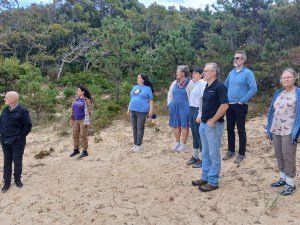
I took a pilgrimage to the Sand Creek massacre site led by an interfaith coalition in partnership with representatives from the Cheyanne and Arapaho nations. An obscene violence pure evil took place there. The land is sacred because it holds the blood and the memories of the people murdered that day. It invites an opportunity to tell the truth, to reconcile and to repair. It invites re-memberance. With the right attention and preparation, this space has the possibility to emerge as a space not simply of harm, but of healing.
We began our pilgrimage to Sand Creek weeks in advance. The organizers sent us videos to watch, histories to read, songs to sing, prayers to say out loud or carry silently in our hearts. We listened, we learned. We prepared.
We met by Zoom so we could begin to form our circle. We met the organizers. We saw each other, we heard each other. We asked questions. We received history, context, orientation, information, and clarification.
The organizers sent us a playlist of songs to listen to as we made our way to the massacre site. We made our journeys with open hearts, with attention and with intention.
The night before we gathered again in person. We shook hands, we talked, introduced ourselves and our family members. We ate together. We met our Arapaho and Cheyenne teachers, mentors, and guides. We listened to them. We formed the circle that would hold us in our shared journey.
Then we went together to Sand Creek.
We stood together. We asked ourselves, “Why did they do this?” But no good answer ever comes to this question. We recognize evil can possess a human heart. We pray for the ones who were murdered. We reach out to them and promise we will re-member. The healing that happened there on that day was more powerful because of the preparation, connection, and prayer that preceded our arrival.
The concept of pilgrimage was taught to me as a young child, although we did not call it that. One of my earliest memories is of being gently lifted from a warm bed in the still dark, carried out to the car, tucked into a nest of blankets and pillows in the back seat (this is before child seats or seat belts were a thing). I would drift back to sleep until the sun’s rays woke me up and I would sit up to watch the sunrise over the mesas on the horizon. In our trunk would be stacks of pies and melons that we brought to share.
My father would pull over to the side of the road before we reached the Hopi village where the Katchinas were dancing and remind me again of the rules: we don’t point, we don’t say some words but do say “Askuali” (or Kwahwhai), we don’t ask questions, we don’t wear a hat or raise an umbrella, we do eat what is on our plate (even/especially the corn with the worm on it). I would slip out of my pajamas and into a skirt. I knew all of these things would happen as part of our family ritual. We did all of these things to show respect and to arrive in a good way. The preparation and the journey itself were also a form of ceremony.
Now, as an adult, when I go to Oak Flat, I follow the journey protocol taught to me by my mentors. I go with attention to the ecological communities that hold me as I travel. Where the ponderosas become piñons, where piñons become creosotes, where creosotes become manzanita – I stop my journey and get out of the car. I look back to where I came from and I thank that community. I blow back any thoughts, feelings which I do not want to carry forward, which do not serve my journey or my destination. I turn to the direction where I am headed and I pray so that I may enter in a good way.
Chi’chil Bildagoteel
Dookó’oslííd/Nuva’tukya’ovi
“Wii’i Gdwiisa”
These are sacred.
AND they are under attack.
They are being diminished and desecrated.
Far away corporations – faceless monsters with many mouths to feed with bottomless pits for stomachs – are attempting to strip these sacred places of their power and reduce them to mere resources. Places where life can be turned into money and then discarded as polluted waste to linger for generations.
Places where – unless we stand and protect them – our children’s, children’s, children will hang their heads and ask, “Why did they do this?” They will take pilgrimages there, with haz-mat suits on, and they will try to make sense of the obscene violence. They will reach out to the land and will say “We are sorry. We are so, so sorry.” They will reach out to the land and promise to re-member.
These places need us to listen and to learn now. So that our children’s children’s children do not have to heal more rifts in the web. They need us to put aside colonized viewpoints and open our hearts to the wisdom of the original peoples who have tended to sacred spaces since time immemorial, who know sacred land as a child knows a mother’s voice. These places need us to dig deep into our ancestral memories and our faith to blow on the embers of the knowledge we carry as well.
We do not do this willy-nilly. These places need us to follow the guidance of elders who can teach us how to pray with respect to their culture, to honor the traditions and protocols their ancestors built through generations of practice. As Reverend Carol Rose says, “Standing with Indigenous people for sacred sites is not something symbolic. In the struggle to protect the earth, it is central.”
They need people who do not take, but give. They need us to prepare ourselves for a longer journey. They need people who will not just visit, take a photo, and then go home, but who will carry the experience of connecting with the sacred long in their hearts and move it into action. They need people who will not walk on them, but who will walk with them, who will accompany them as sacred, living beings.
This post is originally from Lydia Breunig’s Substack, Picking up my bundle, with permission to re-post by the author.
Lydia Breunig lives on land held sacred by many Indigenous nations including Hopi, Diné, Havasupai, Hualapai, Southern Paiute, Ute, Yavapai, Apache, Zuni and other puebloan nations. She is a mother, writer, organizer, and educator. As a descendant of European settlers on Turtle Island, Lydia is striving to decolonize her relationships with land and her Indigenous relatives. Lydia has been researching and writing about her ancestors and their relationship with land before they came to Turtle Island and in the context of settler colonialism. As a Friend, Lydia works with Toward Right Relationship with Native Peoples under Friends Peace Teams and is a member of COFA.