Land Rematriation and Honoring My Mother
Greg Thiessen
In November of 2024, the Coalition announced the Landback Fund, creating an avenue for the collective pooling of resources to assist Indigenous partners with buying their land back. Laura, my wife, and I together chose to make a significant contribution to this fund, 50% of an inheritance gift, in honor of my mother, Judy Thiessen. She passed away on October 27, 2023, following a two-year journey with ALS.
I love and miss my mom dearly. She was an amazing listener and giver of care and love. She had a playful, mischievous spirit that brings a smile to my face even now. Her love for her family and kids was rivaled only by her love for being outdoors and in nature. These are all qualities that I know live on in me – especially playful mischief making. Her legacy is alive and well, carried in the hearts of those who knew and loved her. To honor her through Land Rematriation is one of the ways that I tend to my grief, helping to steady the ground beneath my feet as I journey on without her.
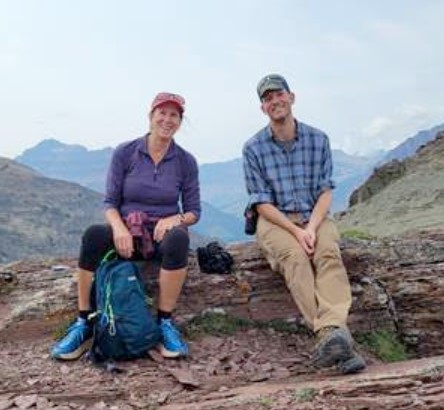
Photo of author, Greg Thiessen, and mother, Judy Thiessen, hiking in Glacier National Park in August of 2021, shortly before her diagnosis with ALS.
On a moral level, I feel the imperative as a descendant of settler colonialism to repair the damage it has wrought – separating people from their land in order to extract resources and wealth. On a practical level, returning lands to Indigenous peoples is a vital strategy in the fight against climate change. Lands stewarded by Indigenous communities safeguard 80% of the world’s remaining biodiversity. Forests on their land are better maintained with a higher preserved biodiversity than those on non-Indigenous lands.
Receiving an inheritance gift meant handling – in the literal sense – generational wealth. When deciding how to return part of this inheritance gift to Indigenous peoples, my immediate impulse was to think backwards in time, tracing the origins of the wealth. I thought about my maternal lineage and their immigration stories, where they settled, and the family business they ran for multiple generations. Starting with the Native Land map resource, I searched for information about the land they lived on and made a spreadsheet of the tribes associated with the land to help me sort through how and to whom I could return a portion of this inherited wealth.
As I worked through this in the midst of navigating grief, I found myself adding complicating questions to the mix. If inherited wealth came from both of my parents, how do I consider the lands that my paternal lineage lived on? What about the other places my parents lived and worked in other parts of the country? My spreadsheet and the list of tribes and peoples to research kept growing. The barriers for me to take a reparative next step kept mounting until I stalled out.
That is until the Coalition announced the Landback Fund in November 2024. The Coalition is doing the sacred work of maintaining relationships with Rematriation partners, following their lead on identifying property for land return. All of a sudden, my desire to return wealth could be part of a collective action with an impact bigger than myself. The Coalition created a simple online donation page where I could contribute to the effort. In the inaugural round, money would be pooled to send to E’lip Tilikum Land Back Program of Na’ah Ilahee Fund, who are running a campaign to return land to the Yakama Nation in central Washington state. The barriers I unintentionally created for myself suddenly were washed away like a sand castle vanishing at high tide.
Perfection is not my guiding value. Repair, right relationship, and care for Mother Earth are. I know that my mom would be really proud and honored by this decision. You can learn more about, and contribute to, the Landback Fund here.
What is mine to do
Laura Schlabach
Talking about money can be hard, especially for Mennonites (not to mention associating our names publically with a gift of money). And, talking openly about different approaches to money and financial decisions has been something Greg and I feel drawn to as part of our lifelong learning about racial and indigenous justice, restitution, and repair.
A helpful, grounding phrase for me this year has been, “What is mine to do?” As someone with financial privilege and generational wealth, I feel clear that part of what is mine to do is shift a meaningful amount of money generously with a mindset toward repair and liberation. Part of what is mine to do is continue having honest and open conversations with Greg about how to live our values through action – something we feel is “ours” to do as a family as well as individuals. Part of what is mine to do is pair this release of money with continued investment in relationship building and community.
When I notice myself lingering in the fog of uncertainty or fear, I remember (and sometimes ask beloveds to help remind me) that remaining in despair or cynicism is not what is mine to do. Rather, what is mine to do is honor grief and actively choose hope as often as possible. It is to celebrate the many ways others are choosing to show up in solidarity and for liberation in ways meaningful to them. This year I’ve had the joy of joining the Coalition’s Investment Justice working group who are digging into such compelling topics like re-imagining security and building capacity for risk taking. Part of what is mine to do is carry on some of Judy’s many legacies: an open-hearted sense of curiosity and deep love for the earth.
Robin Wall Kimmerer writes in Braiding Sweetgrass, “Even a wounded world is feeding us. Even a wounded world holds us, giving us moments of wonder and joy. I choose joy over despair. Not because I have my head in the sand, but because joy is what the earth gives me daily and I must return the gift.”
What a gift it is to be able to actively choose hope and repair by including the Land Back fund in our financial planning.
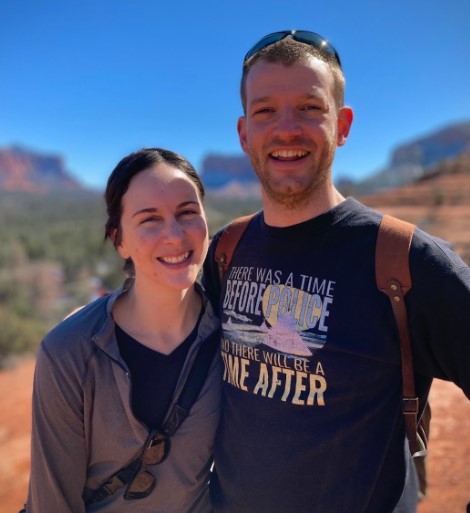
Laura Schlabach (she/her) lives in Seattle, Washington, on the ancestral lands of the Duwamish and Coast Salish who are still here today. Her household includes her husband Greg, two beloved cats, Gus and Keiro, and usually a flock of four backyard hens. She is a member of Seattle Mennonite Church, part of the Coalition’s Investment Justice Working Group, and on the leadership team for the Mennonite Action Washington Chapter. Spending time with her niblings, family, and friends is one of her greatest joys.
Greg Thiessen (he/him) lives in Seattle, Washington, on the ancestral lands of the Duwamish and Coast Salish who are still here today. He is a member of Seattle Mennonite Church, and on the leadership team for the Mennonite Action Washington Chapter. When he’s not biking around the city, he can often be found sitting at a quilting frame, which makes him feel connected to his mom.
Have you given to the Landback Fund? Comment below why you give!