“When songs are ‘sticky’ they have more potential to transform you, us, me as the words and melodies marinate and ferment in us. The ground of our being starts to shift.”
– Conie Borchardt, Executive Director of Music that Makes Community
The Earth that surrounds us, grounds us, and sustains us is sacred. Yet over generations of colonization, capitalism, and greed, many of us have lost that sacred connection. Music is one language of many that connects the kinship of life with the movement of Spirit. Music also provides people a way to speak truth to power, uniting communities with language, movement, and energy that make up the counter-narratives to dismantle empires.
Over the past few years, the Coalition to Dismantle the Doctrine of Discovery in partnership with Music that Makes Community have been working to create a playlist of songs that highlight our mutual interdependence on Mother Earth.
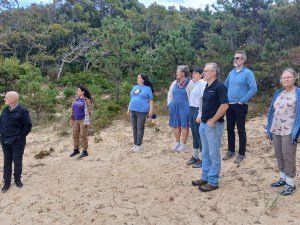
On October 2nd, 2024, some of these songs were shared during a public event taking place both over zoom and in-person at United Theological Seminary of the Twin Cities. Song writers led participants through selected songs from the Sacred Lands Playlist, highlighting the themes of gratitude, interconnection, grief, renewal, and rematriation (to name a few).
One song from our collection has already made an impact. At St. Clement’s Anglican Church in Vancouver, BC, CA, the congregation incorporated Teri Gruthaner’s song, “Return to the Sacred” as a land acknowledgment, sung by the choir, to begin every worship service throughout the month of September.
“Return to the Sacred” was written about the long history and return of Iⁿ‘zhúje‘waxóbe, the Sacred Red Rock of the Kanza people. Iⁿ‘zhúje‘waxóbe was formally returned to the Kaw Nation in August 2023, and rematriated to Kanza land in June 2024. Themes around St. Clements’ event and the month-long inclusion of the song included historical truth-telling and learning, music as worship and confrontation of empire, and accountability to the commitments of decolonization and action (paraphrased).
In recounting her journey to write this song, Teri shares the following:
“I asked spirit to help me find a resonant song for this momentous moment of returning Iⁿ‘zhúje‘waxóbe. For weeks, I listened and sang songs that I’d learned from beloveds over the years, but nothing was hitting the energetic cord I was longing to be strummed. One night during the week of the return, while singing my baby to sleep cocooned in the dark night, these words poured out and wove themselves into melody. Within minutes, the song was complete. It felt effortless, like the pieces just fell into place. I had tried creating community songs before, but could never finish them to satisfaction. I chuckled to myself, “Is that what people mean by ‘catching’ a song?!” What joy I felt as I sunk deeper into the prayer of the song.”
“Return to the Sacred” made its way to Canada via a Sacred Lands Playlist song circle hosted by Doe Hoyer and Conie Borchardt at the 2024 Hymn Society conference held in Atlanta, Georgia. Becca Whitla shares about her experience learning the song there and then sharing it at another conference:
“I learned the chant at the workshop in Atlanta at the Hymn Society conference. Days later I was speaking in Regina, Saskatchewan at the national Anglican-Lutheran worship conference. The theme title (chosen by me and the other two keynotes), was Stones Cry Out; Praying with the Land. My talk was entitled: Are we listening? Decolonial Action in and through Worship
Of course, I couldn’t resist teaching the song and sharing the story. That’s how Lynley (musical director at St. Clement’s Anglican Church) learned about it. I was also deeply moved when the National Lutheran Bishop Susan Johnson then sang it in her closing reflection/sermon. There was some shifting energy at the conference and a tremendous sense of hope. Teri, your chant was a contributing factor. Thank you! It was one of those moments where things align in wonderful mysterious ways. I love how songs actually can shift things and change us!”
After learning the song from the Anglican-Lutheran worship conference, Lynley Lewis reached out to Teri to ask if he could record and post a YouTube video of his choir singing the song. These were his reflections on the songs meaning to him:
“It’s so hard to summarize what a profound influence this chant has had on my heart and mind. In the hours spent recording and editing the video footage, I had the opportunity to conduct some historical research and deeply reflect on the words of this heartfelt lament. The most enlightening lesson for me was knowing that the strength of a community is strong enough to move even a mountain!
I am reminded of a scene from the “Lord of the Rings: The Rings of Power” series on Prime Video where Princess Disa, the Dwarvian prince’s wife, sings to the mountains in which they are mining. She explains it as “a plea to the rocks to release the bodies of the miners with breath still inside them” after a mining accident occurs.
This next scene shows an actual shifting and trembling of the mountain as Disa is singing. The notion of the mountain responding to her prayer really resonated with me. I feel that the Iⁿ‘zhúje‘waxóbe | Sacred Red Rock has been absorbing centuries’ worth of human interactions that have now been quietly embedded deep within its grains and grooves. The Sacred Red rock has stood as a silent sentinel and enduring testament to the history of the people on the land. I take inspiration from this story and try to absorb as much as I can into my daily life.”
Along with “Return to the Sacred”, there were several other song contributions that were shared at the release event. Songs like “Right Relationship” (Liz Digitale Anderson), “Let The Earth Live Through Me” (Moon Clemetson), and “The Earth is a Web of Life” (Patricia Plude) were shared and sung together during this event. Through sharing and singing, the release of the first part of the Sacred Lands Playlist was met with enthusiasm and energy, promising to call more songs to be received into this playlist in the future.
One of the first times that I heard selected songs from the Sacred Lands Playlist was at the 2024 Coalition annual gathering held in Minneapolis, MN. It took some time before I decided to join the circle, but I was grateful that I eventually did. That was one of the blessings of these songs – there was no force applied in joining the circle, but once you made the choice to join you were greeted by the energy of the collective, the rhythm of shared voices, and the grace of many people singing from their bodies and souls. The rest of the weekend together was woven gracefully with the beadwork of these songs creating a mosaic tapestry, tenderly created for longevity as well as beauty.
Since then, there have been many moments where both longevity and beauty have been essential to continuing in this urgent and sacred work. There have been points along this journey of collective grief, forged joy, and tense anticipation for change. Music acts as a combination of air/spirit, body, and soul – something that transcends our individual selves and yet sounds and moves in unique and powerful ways when we each are included. It is in these moments of strain and work that singing together reminds us of who we are, how we fit into the larger collective, and strengthens us for the journey ahead.
If you would like to access the Sacred Lands Playlist, I invite you to visit the Coalition to Dismantle the Doctrine of Discovery’s playlist webpage.
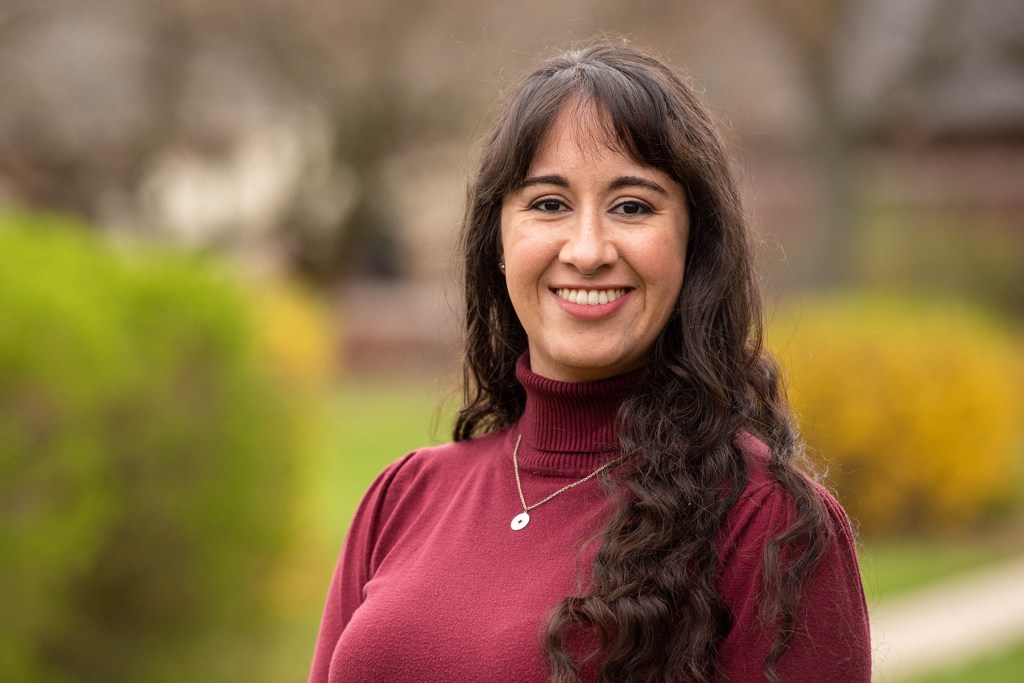
Sara Peachey (Gurulé) is a mixed-indigenous woman (Apache, Spanish, and Basque) currently living in the eastern part of Pennsylvania, though she is originally from central New Mexico and the Central Valley of California. Sara is passionate about the connections between the natural world and the practices of her faith, which have driven her work in both environmental and social justice work. She holds a Bachelor’s Degree in Biblical and Religious Studies (minoring in environmental studies) as well as Master’s Degree in Theology and Peace Studies (concentrating in environmental sustainability). Sara currently works at Mennonite Mission Network, is a volunteer with the Coalition to Dismantle the Doctrine of Discovery, and is involved with both local and national justice movements.