This letter was originally written to the Pacific Northwest Mennonite Conference (PNMC) ministry leaders on Indigenous Peoples Day (October 14th, 2024).
Note: The letter that follows includes reference to graphic violence
Dear PNMC Ministry Leaders,
Twenty-five years ago, I sat in an Iliff School of Theology class led by George “Tink” Tinker, member of the Osage Nation, theologian and scholar of indigenous peoples’ history. Tink shared a story that for many of us, especially those of us who had (and still have) much to learn about the colonization of the lands we call home, seemed as impossible as it was horrifying.
Tink shared the story of a book that had been donated to the Iliff School of Theology library at the end of the 19th century. It was a book about Christian history, and it was donated by a family with connections to Colonel John Chivington (1821-1894). Chivington was an ordained Methodist pastor and colonel in the United States Cavalry in the Colorado Territory, and he led one of the most horrific atrocities committed against indigenous peoples, the Sand Creek Massacre of November 1864.
This particular book of Christian history had not been bound in leather from a cow’s hide, but from the skin of an unknown Indigenous Man.
Sit with that for a moment.
A book of Christian history bound with the skin of a human being, a beloved child of God and bearer of God’s own image.
For many years, that book sat in a glass case in the special collections of the Iliff School of Theology library. People would later plead innocence as to knowledge of the book’s origins.
Let us sit with that, too–that willful ignorance, and chosen forgetfulness.
I would later learn, while doing further research for Tink’s class, that the information about the book’s lineage was there in the library archives for all to find. There were letters and old news articles lauding the generous donation of the book from the family, some of it forthrightly acknowledging the source of the book’s cover. It was there, but it was ignored.
The true story of the book was later revealed, and in the 1970’s the American Indian Movement demanded that the cover of the book be removed and returned for proper ceremonial burial. The Indigenous Man’s skin was removed from the book and returned. However, a non-disclosure agreement was signed at the time, silencing the role played by the school, where the book had been on display for eight decades.
When I went to the Iliff School of Theology Library and Archives for my own research on this story, I found the book stored in a gray, acid-free box. I held it, a book of Christian history. And I sat for a long time considering its terrible story–our terrible story.
Today, on this Indigenous Peoples Day, I can still see that book, and feel its weight in my hands. Even more, I sense the weight of that book, and all that it represents, on us as the church. We are inheritors of this history.
For most of us, the lands we now call home are lands that were forcibly, violently and murderously claimed. And very often, these atrocities were committed in the name of Christ, under the twisted and rapacious theology that goes by names such as “Manifest Destiny,” and “The Doctrine of Discovery.”
We must be willing to sit with this. To feel this, and know that this is part of our story.
We must we willing to learn and remember these stories of the complicity of the church in the mass genocide of indigenous peoples, here and around the globe. We must be willing to deconstruct and awaken to the ways these histories shape the privileges by which we live today and shape the extractive, consumptive patterns that continue to fuel our human living and harm the earth and our neighbors.
On this Indigenous People’s Day I am taking time to sit once again with this painful story I first heard from my teacher, George “Tink” Tinker, and to also turn to another teacher whom I’ve met more recently in my journey, Sarah Augustine.
Many of you know Sarah and her work with the Coalition to Dismantle the Doctrine of Discovery. Sarah is a member of Seattle Mennonite Church, and is part of our PNMC community. I am grateful that she has been invited into a number of our congregations to offer teaching and her prophetic challenge to the church.
If you do not already have other ways to mark this Indigenous Peoples Day, will you join me in going to the Coalition to Dismantle the Doctrine of Discovery website and learning from some of the rich resources made available there? Perhaps you will encounter something that sparks your own growth, and our collective action.
I will also commend to you this excellent conversation between Sarah and indigenous activist and teacher, Mark Charles, on Mark’s YouTube channel, “My Second Cup of Coffee”:
My Second Cup of Coffee: A Conversation with Sarah Augustine, author of “The Land is not Empty”
May God have mercy.
May Christ transform us with love.
May the Holy Spirit guide us on the pathways of wisdom.
Your sibling in Christ,
Eric Massanari
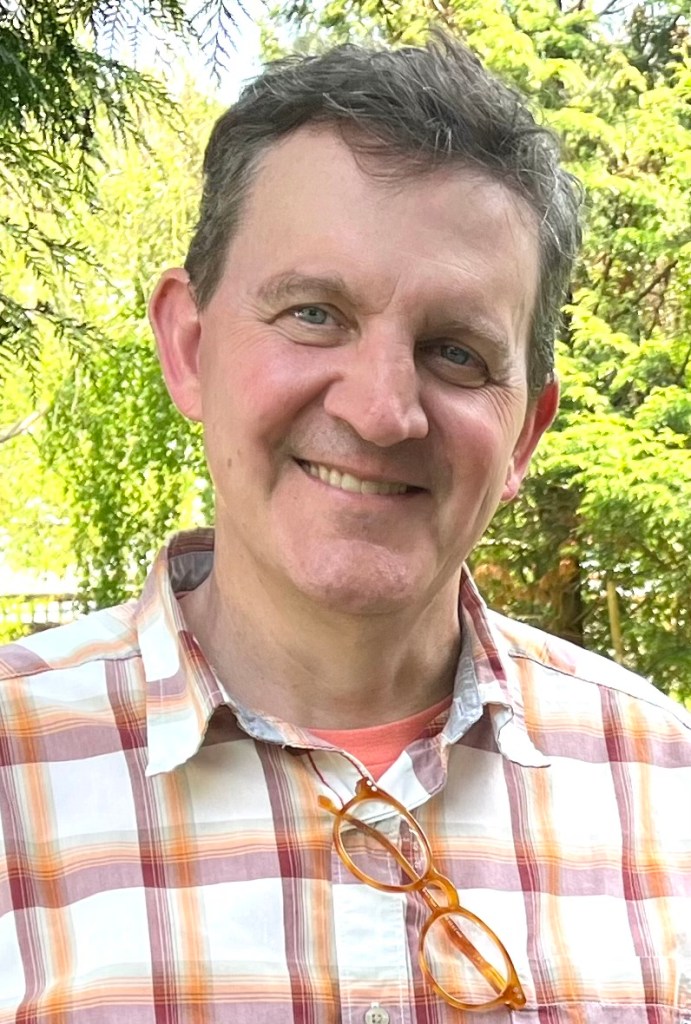
Eric Massanari (he/him) serves as the Executive Conference Minister for the Pacific Northwest Mennonite Conference of Mennonite Church USA. Eric’s previous ministry roles included congregational pastoral ministry and chaplaincy in a healthcare setting for older adults. He is also a trained spiritual director and continues to offer spiritual direction and supervision in private practice. Eric and his wife, Yolanda Kauffman, live in the Lake Whatcom Watershed in northern Washington state, on the ancestral homelands of the Coast Salish Peoples, particularly the Lummi Nation and the Nooksack Tribe.