Part I
Tzukan snake is the special guardian of water. It lives in water sources and she is the spirit of water and rain. It is a snake (Kan), with long yellow hair like the hair of corn (Tzuk). When she grows old and its life cycle is fulfilled, Tzukan begins to grow wings with colored feathers like the Quetzal. Once she has grown wings, she flies to the sea, to the Gulf of Mexico, where she dives to die. But, at the very moment of her death, another snake is born in the same water source, so that the precious water will always have a guardian spirit to watch over it.
This is just a little taste of the amazing oral history of our Maya grandmothers and grandfathers. In some other stories, Tzukan carries K’ankabi Ok (Walker or Traveler) on her back and spreads her colorful wings to the most remote places in the world in search of X-Hail (She of the water).
Rain Territory

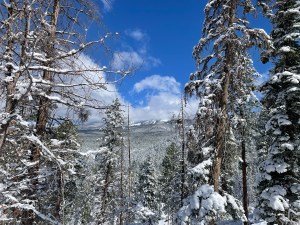
Takhoma from the plane
In April 2024, while flying from Pasco to Seattle in the United States, I was fortunate to be able to view the majesty of Takhoma (aka Mount Rainier) from the plane window. My neighbor in the window seat also enjoyed the view.
She probably read the excitement on my face and kindly moved away from the window to let me take some pictures with my cell phone. As you can imagine, the camera does not do justice to what the eyes see.
Could this be a sacred mountain for the Indigenous Peoples of the region? I wondered.
As we slowly rounded the west face of the mountain, the ambient noise of the turbines was occasionally interrupted by familiar phrases such as “This is your captain speaking (inaudible). In a few minutes…”
Anyway, my mind was busy on other things. Immersed in recent memories, I tried to find sensations similar to those I was experiencing on the Takhoma at that moment.
All of a sudden Tzucan & K’ankabi Ok reappeared… Several months ago, while reading one of the printed versions of the story of K’ankabi Ok, by Domingo Dzul Poot, my mind sketched a landscape with forested mountains crowned by clouds and fountains of water leaping and running down their slopes. A landscape very similar to that of Takhoma, which seen at 9,000 meters above sea level, seems to unweave its blanket of snow along the banks to transform into a number of meandering rivers and lakes scattered throughout the area.
Takhoma, it seemed to me that very place I sketched where Tzucan & K’ankabi Ok flew to meet X-Hail.
Part II
Yakama Territory
My visit to Seattle was part of the “West Coast Speaking Tour” sponsored by the Coalition to Dismantle the Doctrine of Discovery. Through my good friend Sarah Augustine, founder of the Coalition, I had the privilege of giving a presentation at Heritage University on the Yakama Indian Reservation. It was an honor to share with Indigenous students and researchers some of the learning from our nearly 8-year collaboration with the Coalition.
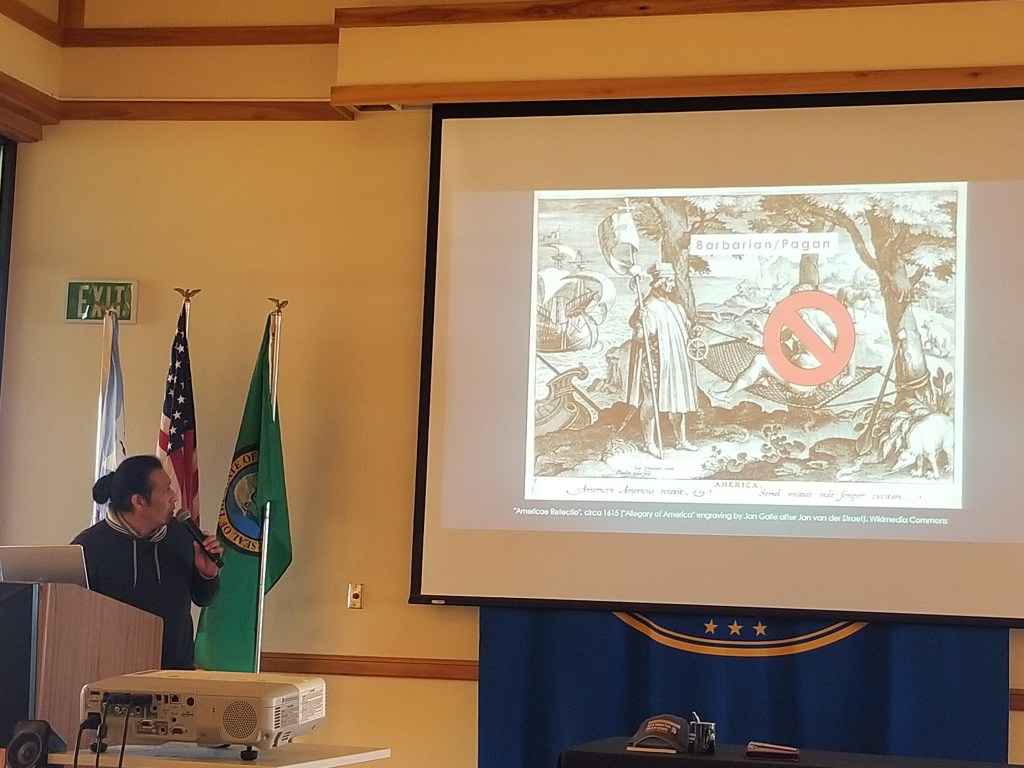
Manuel May presenting at Heritage University
Over the course of our collaboration, we have been exploring the impact of the
Doctrine of Discovery in Mexico. Through our joint efforts, we have gradually been able to identify certain legal processes that were used to dispossess the Maya peoples of their ancestral territories and sacred sites, by accusing them of paganism and savagery.
As you may already be aware, the accusations of paganism and savagery were instrumental in the juridical Doctrine of Discovery, which led to the unfair legal dispossession of Indigenous Peoples from their territories.
In some historical accounts, it was suggested that in places like Uxmal, “detestable sacrifices” were carried out in order to persuade the Spanish crown to grant Maya lands and inheritance to its creole subjects.
Xučyun Territory (Huichin)
Seattle was followed by San Francisco, California, where, through Pastor Sheri Hostetler and thanks to Prof. Patricia Baquedano-López, I was invited to give one more talk at the Latinx Research Center at the University of California at Berkeley.

Manuel May speaking at the Latinx Research Center of UC Berkeley
On this occasion, I had the pleasure of sharing that the Mayan oral tradition is a truly rich source of knowledge that helps us to better understand the symbols in the ancient temples. For example, in the Tzucan stories we can find the meaning of the stone reliefs depicting the feathered serpent in Maya temples such as Uxmal. The serpent as guardian of water suggests religious themes and rituals related to the care and profound respect for water.
First and foremost, I insisted that this knowledge is essential for water policy makers in Mexico to understand how Mayan peoples have related and connected to water since time immemorial. It is crucial that all stakeholders in water policymaking understand that in the Mayan worldview, water is a being belonging to the realm of the divine and is therefore sacred.
Naturally, all of this is best perceived through the use of the Mayan language. For example, we name the Rain Yuum Chaak, using the prefix Yuum in a similar way as it is used for Jesus Christ, Yuum Jesus.
Part III
The next day, Sheri Hostetler, friend and the co-founder of the Coalition, hosted a dinner at her home to informally share more details about my presentation in Berkeley with guests from her congregation. At some point during the dinner, we had a lovely joint reflection on the contrasting values between the colonial friars and the Maya peoples regarding the symbol of the snake. While the former saw the devil in the feathered serpent, for the Maya it represented and still represents water, the primordial source of life.
It seems that the friars colonial interpretation was in line with the Doctrine of Discovery. But surely there are other interpretations of the Bible. And why not? Perhaps it’s time to explore some decolonial readings.
The next day, a plane took me from San Francisco to Los Angeles for my last performance on this tour. By this time, my body was completely exhausted, but my spirit was still full of energy. To be honest, I was really excited to meet the congregation in Pasadena, California. Katerina Gea, the Pastor of Pasadena Mennonite Church, and a great friend of mine, convened a seed party at the Sharp Residence.

Manuel May sharing at Pasadena Mennonite’s Seed Party
We had a delicious dinner with plenty of hot sauce, and we got to chat about the importance of caring for and preserving native seeds and the ancestral knowledge around them. Naturally, talking about native seeds led us to talk about rain.
On the theological side, it was easy to communicate with the Christian congregation that for us Rain is a divine being. It was also easy to understand why stories like the Tzukan serpent and rituals have survived centuries of colonial persecution (even at present). Our ancestors must have been so confident that the day would come when these values would prevail over colonial injustices and violence. And we seem to be reaching that day!
It is clear that Indigenous wisdom and values, including those of the Maya, have withstood several centuries of Inquisition and are now valued as essential in contributing to the search for solutions to the global climate crisis. The UN has made it clear that the relationship Indigenous Peoples have with water and nature is essential to combat climate change, and at present more and more countries are recognizing bodies of water as subjects of law, just like humans…
Mayan Territory
As if awakening from a dream, I find myself shuddering with excitement as I look out the window and contemplate the deep blue of the Gulf of Mexico. I am also thrilled to land soon in Mayan lands. I have a date with the amazing friends of our collective (CILLI) to celebrate together the seed party! As the dry season is coming to its end seeds must be shared and prepared to be planted and embraced by Mother Earth to await the arrival of Tzukan.
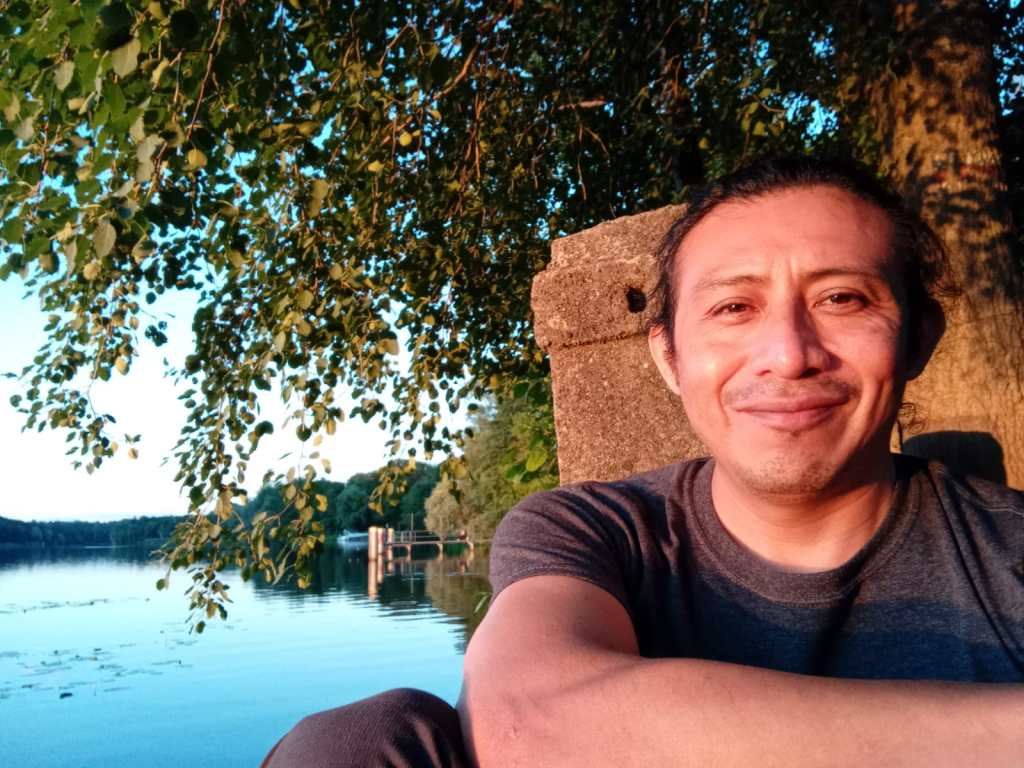
Manuel May is a Maya Indigenous scholar from the Yucatan Peninsula, Mexico. Manuel holds a PhD in Architectural Heritage from the Polytechnic University of Valencia, Spain. His area of research lies at the intersection of Indigenous heritage, archaeology and sociocultural anthropology.
His work encompasses the socio-political dimensions of Indigenous heritage and methodological considerations for a rights-based approach to research. In November 2017 he was awarded a grant as a Principal Investigator by the European Union – Marie Skłodowska-Curie Actions and the German BMBF (04/2018 – 09/2019) to investigate the Mayan cultural landscapes and archaeological sites threatened by industrial cultivation in Hopelchen, Campeche, Mexico.
Manuel’s work at the global level includes conferences and lectures at various universities and museums around Europe and the Americas, and steady participation in United Nations forums on Indigenous issues, i.e. EMRIP and the Permanent Forum. Currently, Manuel researches the role of Indigenous delegates and representatives in the production of knowledge and norms at the UN level.