I remember the first time a song really made me cry.
It was towards the end of a community singing weekend, and it was a group of about forty voices singing the chorus of Trees Grow Slow that moved me to tears. To sobbing, actually. I was far too emotional to sing or learn the song, but I took in the message, tears streaming down my face, about the shared love we have for our Earth kin, and how we must still look to their wisdom, and towards relationship, in these times of devastation.
The song landed for me in just the right moment to crack my heart open. To make me feel enough to really care about what’s happening to the Earth.
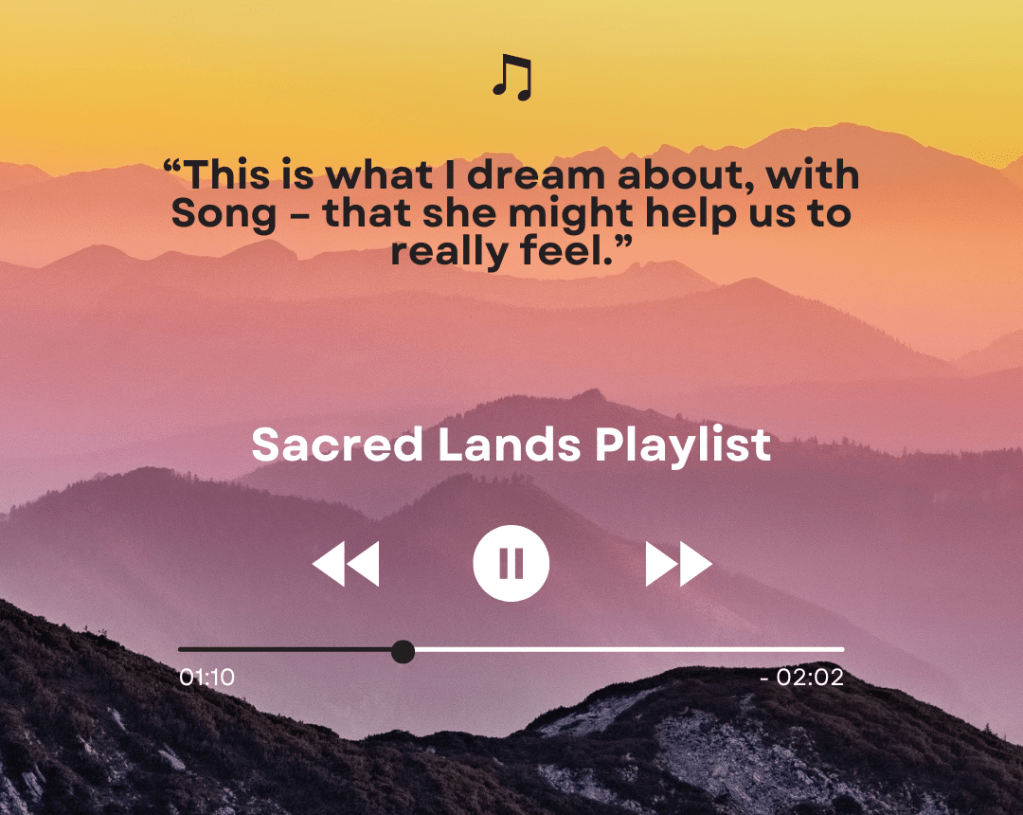
I’ve learned that Song can do that for people. I think sometimes Song descends like a blessing, to shine into the hidden places, and bring forward, through entwined voices, our longing for Life and love and connection. This is what I dream about, with Song – that she might help us to really feel.
I dream of more songs that open us up to feel our love for the Earth, to weep for the ongoing extraction and harm to her lands and waters and creatures. I dream of more songs that will commit us, faithfully, to honoring and organizing in solidarity with Indigenous Peoples – our relatives who are largely responsible for the preservation of Earth’s remaining biodiversity worldwide. I dream of more songs that don’t overlook the Indigenous stories of the land, but rather call us into the transformative work of reparative justice, relationship, relinquishing control, and beginning to heal generations of harm done by colonization, colonialism, and white Christian supremacy.
Sometimes it is our dreams, our unique visions, that lead us into our most inspired organizing – into the pursuit of earnest questions, conversations, connections, partnerships, and projects.
In holding this vision for songs to support this work, I was happy to be directed to songleader friends Conie Borchardt and Paul Vasile at Music that Makes Community, who found alignment with the Coalition’s vision for Indigenous justice and the playlist project’s grounding as a resource for cultural change within Christian congregations.
Since our formation in the fall of 2022, the collaborative MMC/Coalition playlist working group has had many conversations to determine our shared vision and goals for the project.
An orienting question has been: how will we center Indigenous voices and activism via this playlist of songs, knowing our intended audience is folks of the dominant culture, knowing our purpose is cultural change that moves these folks into organizing for structural change and reparative justice?
After considering these factors, we decided on a theme of Sacred Lands. We call in songs that can help to shift the dominant culture’s perception of land as commodity or resource, towards respect for Indigenous worldviews which recognize the sacredness of Earth and our relationships with all of our human and more-than-human relatives. We call in the songs that will help us organize – the songs that will lead us to personal, spiritual, cultural, and systems-level transformation.
Last month, as a launch for sharing this call for songs with people in our networks, Conie and I hosted an online Soup Singing event. We invited attendees to connect with us from their home kitchens, chopping vegetables for soup while learning songs which brought forward stories of repair and organizing for Indigenous justice happening within the Coalition.
For some, this was their first introduction to the Coalition’s work. Over bowls of soup, per the practice of Music that Makes Community, Conie asked us to reflect on what we noticed about the singing. I heard several participants start their sentences with “I feel…”
I am reminded, once again, of Song’s power to do that.

Doe Hoyer is an organizer and songleader with the Coalition to Dismantle the Doctrine of Discovery, and coordinates the Repair Network. They have lived on Dakota homelands for most of their life, and are involved locally with the Twin Cities Repair Community for Makoce Ikikcupi (Dakota land recovery), as well as the Twin Cities Ceasefire Choir. Doe was raised Lutheran, but their spirituality is authentically Earth-based, which calls them into solidarity with Indigenous Peoples. Doe is working on completing their Master’s of Divinity in Social Transformation.
Check out our Sacred Lands playlist
Volume 1 of Sacred Lands: Community Singing is out now! We will be releasing a second volume in 2026.